

A child brain injury lawsuit generally requires evidence answering three fundamental questions: what happened, who was legally responsible, and how did the event affect the child?
The strongest cases usually combine evidence about the accident with medical records linking the event to the brain injury. They also document how the injury has changed the child’s health, functioning, and future needs.
No single piece of evidence proves every case.
What must the evidence establish?
In a negligence case, evidence generally must support the existence of a legal duty, a breach of that duty, causation, and damages. Applied to a child’s brain injury, that means showing:
- Someone had a legal responsibility toward the child.
- That person or organization failed to meet the applicable standard.
- The failure caused or contributed to the child’s brain injury.
- The injury resulted in legally compensable harm.
Different types of evidence may be needed to prove each element.
The importance of medical records
Medical records are often central to establishing both injury and causation. They can establish when symptoms first appeared and what diagnoses were made. They may also show what treatment the child received and how the condition changed over time.
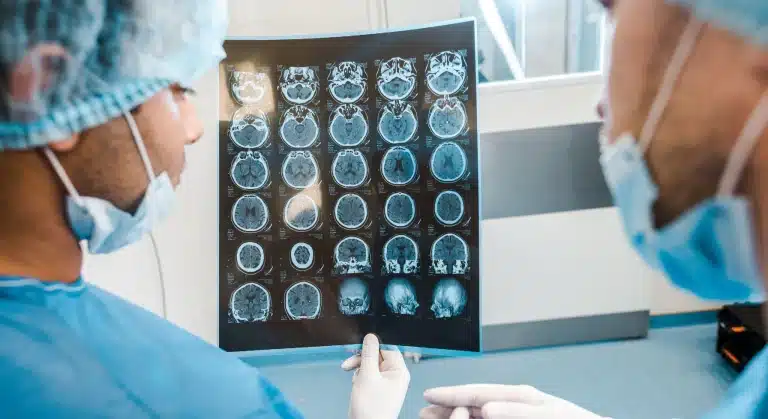
The medical file may begin with ambulance, emergency department, and hospital records from immediately after the accident. Later documentation may come from the child’s pediatrician, neurologist, neurosurgeon, or rehabilitation providers. Diagnostic imaging and neuropsychological evaluations can also become important depending on the nature of the injury.
Finally, treatment records from physical, occupational, and speech therapy may further show how the child’s abilities changed during recovery.
Because brain injuries do not always produce immediately obvious symptoms, records created over time can be particularly important. The CDC recognizes that concussion symptoms may emerge or become noticeable hours or days after an injury.

Is a CT scan or MRI required to prove a brain injury?
Not necessarily. The American Association of Neurological Surgeons notes that imaging cannot always detect damage from mild concussive injuries. A normal scan therefore does not, by itself, rule out every mild traumatic brain injury (TBI).
The CDC’s pediatric mild TBI guidelines advise clinicians not to routinely use CT or MRI to diagnose mild TBI in children. Diagnosis may instead depend on the child’s symptoms and clinical examination. Doctors may also assess cognitive function, balance, memory, and other neurological findings.
The appropriate medical evidence therefore depends on the child’s particular diagnosis and condition.
Evidence that helps prove how the accident happened
The evidence needed to reconstruct the accident depends on where and how the injury occurred. Potential evidence can include:
- Police reports
- School or daycare incident reports
- Photographs
- Video recordings
- Surveillance footage
- Witness statements
- 911 recordings
- Maintenance records
- Inspection records
- Employee schedules
- Safety policies
- Training records
- Vehicle data
- Product records
- Communications, emails, or text messages
A school injury, for example, may require very different records from a motor vehicle collision. Product defect and medical malpractice claims can require different evidence as well.
Why does surveillance footage matter?
Sometimes, video can provide direct evidence of how an accident occurred. For instance, footage may show how a child fell or whether responsible staff were present. It can also reveal how long a child was left unsupervised, the condition of the surrounding area, or the sequence of events leading to a collision. In some cases, the moments immediately after the injury may be equally important.
However, surveillance footage is not necessarily preserved indefinitely. Recordings may be routinely overwritten or deleted, making it important to take steps to preserve relevant evidence early in the process.

What records can show that safety rules were violated?
An investigation may compare what actually happened with applicable requirements or standards. Relevant material could include:
- Internal safety policies
- Employee manuals
- Training records
- Government regulations
- Building or maintenance requirements
- Product instructions
- Sports concussion protocols
- School policies
- Daycare licensing standards
These records can help show what precautions were expected and whether they were followed. While a policy violation alone does not automatically establish liability, it may become relevant to determining whether reasonable care was exercised.
Evidence that helps connect the accident to the brain injury
Causation can be especially important when symptoms are delayed or when the child had a prior medical condition. The evidence should help establish the child’s condition before the accident, when symptoms appeared, and how the condition changed afterward. It may include:
- Medical examinations
- Diagnostic findings
- Neurological evaluations
- Expert medical opinions
- Records showing the child’s pre-accident condition
- Records showing changes after the accident
Legal causation asks whether the defendant’s conduct actually and legally caused the claimed harm. In a complex brain injury case, medical specialists may be needed to explain whether the accident caused the child’s condition.
Can school records be used as evidence?
Yes. School records can sometimes provide important evidence of how a brain injury changed a child’s functioning.
Grades and standardized test results can show changes in academic performance. Attendance records may document increased absences, while teacher observations and disciplinary records can reveal behavioral or emotional changes. For children receiving additional support, IEP documents, 504 accommodations, or school psychological testing may help show how the child’s educational needs changed after the injury.
For example, a child may have performed well before an injury but later struggle with concentration or memory. School records may document declining grades, increased absences, or changes in behavior that help show how the injury affected the child over time.
The CDC recognizes that concussion symptoms can affect a student’s ability to learn and may affect classroom performance, mood, and behavior.
Why is evidence about the child before the injury important?
Brain injury cases often require a comparison between the child’s functioning before and after the event. Pre-injury records can establish a baseline. They may show how the child was developing academically, physically, and socially before the accident occurred.
Pre-injury evidence can include:
- Pediatric medical records
- School performance
- Developmental milestones
- Sports participation
- Extracurricular activities
- Test results
- Statements from teachers and caregivers
That baseline can then be compared with the child’s post-injury functioning to identify meaningful changes.

What evidence helps prove future damages?
For a child with long-term impairment, the case may need to address needs extending decades into the future.
No single expert necessarily evaluates every aspect of those needs. Medical specialists may address the child’s prognosis, while rehabilitation professionals can evaluate functional limitations and ongoing treatment. Other experts may focus on education, independence, or future financial losses.
Their opinions may help estimate future medical treatment, therapy, educational support, equipment, and personal assistance. They may also address the child’s likely level of independence and future earning capacity. Ultimately, these records and expert opinions can become evidence used to calculate the long-term value of a brain injury claim.
Should parents keep their own records?
Yes. Parents should keep an organized file of expenses and communications related to the injury. Medical bills, appointment records, therapy schedules, and equipment expenses can document the financial impact of treatment. Likewise, it is useful to preserve communications with schools and insurance companies, along with photographs and accident-related correspondence.
A journal documenting brain injury symptoms after an accident may also help track changes over time. For example, parents can record changes in sleep, behavior, concentration, or daily activities as they occur. Entries should focus on what the parent actually observes rather than attempting to provide a medical diagnosis.
Preserve the evidence that may matter to your child’s case
Evidence in a child brain injury case can disappear long before the legal filing deadline expires. Surveillance footage may be deleted, physical conditions may change, records may become more difficult to obtain, and witnesses may forget important details.
A child brain injury lawyer can identify the evidence needed to investigate negligence and establish medical causation. They can also help document how the injury has affected the child and assess what future needs may arise.
Early investigation can help preserve evidence before it is lost and may also reveal additional individuals or organizations that may be responsible for the injury. The Killino Firm represents children and families in serious brain injury cases and can review what evidence may be important in your child’s situation.
Get your free, confidential case evaluation. Call 24/7 at 878-888-7878 or contact us online.
No upfront fees; client pays no legal fees unless a recovery is achieved.
The information provided on this site is not formal legal advice. Prior results do not guarantee a similar outcome. Confidential consultation is required.