

Hypoxic-ischemic encephalopathy (HIE) is a form of brain damage caused when a newborn’s brain is deprived of adequate oxygen and blood flow during or immediately around the time of birth, and an HIE birth injury lawsuit is a legal claim against the doctors, nurses, hospital, or other medical providers whose failure to prevent or respond to that crisis caused the injury. According to the National Institutes of Health, HIE affects approximately 1.5 to 2.5 per 1,000 live births in developed countries — and in many cases, it is directly caused by obstetric negligence such as missed fetal distress, delayed emergency C-section, or other failures during labor and delivery.
Another preventable cause of newborn brain injury is newborn jaundice, when it is not treated in time.
For parents and guardians of babies or children diagnosed with HIE and facing lifelong medical, therapy, and support needs, the legal questions can be as urgent as the medical ones. Just as a medical team’s failure to intervene immediately can cause irreversible brain damage in minutes, delaying legal action can permanently jeopardize your family’s ability to secure lifelong financial compensation.
Key Takeaways: Legal Rights for Children and Families After an HIE Diagnosis
- HIE is frequently preventable. Failure to monitor fetal heart rate, delayed emergency C-section, and mismanagement of umbilical cord complications are leading causes of actionable medical malpractice.
- Statutes of limitations are often tolled for minors. Some states pause the filing clock until the child reaches the age of majority, but rules vary significantly — and some states impose absolute deadlines regardless of the child’s age.
- You may be entitled to lifetime compensation. Recoverable damages in severe HIE cases include lifetime medical care, assistive technology, in-home nursing, lost earning capacity, and pain and suffering.
- Court approval is required for minor settlements. Any settlement reached on behalf of a child must be reviewed and approved by a judge to ensure the child’s interests are protected.
- Expert testimony is mandatory. Every state requires that a qualified medical expert testify that the standard of care was breached. Our team has the most rigorous board-certified obstetric and neonatal experts in the country.
- The window to investigate is limited. Hospital records are preserved for fixed periods, and evidence — including fetal monitoring strips — can be lost. Contact our team of birth injury lawyers immediately after a diagnosis.
What Is Hypoxic-Ischemic Encephalopathy, and How Does It Damage a Newborn's Brain?
HIE is a two-part injury. “Hypoxic” refers to reduced oxygen supply; “ischemic” refers to reduced blood flow. Together, these mean the newborn’s brain is deprived of adequate oxygen and blood flow because of insufficient oxygen reaching the infant’s brain during labor or delivery. The brain damage that results can occur during labor, during delivery, or in the immediate newborn period. HIE occurs when the baby’s brain is deprived of oxygen long enough that brain cells start to die. The American College of Obstetricians and Gynecologists (ACOG) recognizes that prompt recognition of fetal distress and rapid delivery are among the most important interventions in preventing permanent neurological injury.
What Are the Three Grades of HIE Severity, and What Do They Mean for My Child’s Future?
HIE is clinically staged using the Sarnat Grading System, which classifies injury severity as mild, moderate, or severe:
Mild HIE (Sarnat Stage I)
- Irritability, poor feeding, hyperalertness
- Muscle tone is mildly altered
- Symptoms typically resolve within 24–48 hours
- Risk of long-term disability is lower but not zero
Moderate HIE (Sarnat Stage II)
- Lethargy, significantly reduced muscle tone, seizures
- Requires active treatment and monitoring
- Risk of cerebral palsy, epilepsy, cognitive impairments, and developmental delays; HIE accounts for an estimated 10-15% of cerebral palsy cases
- Outcomes are highly dependent on the speed and quality of treatment
Severe HIE (Sarnat Stage III)
- Deep coma, absent brainstem reflexes, multi-organ failure
- Approximately 15%-20% of infants with HIE die, and survivors often face lifelong disabilities
- Survivors face a high probability of severe cerebral palsy, blindness, deafness, and complete dependence on caregivers for life
The National Institute of Neurological Disorders and Stroke confirms that the severity and duration of oxygen deprivation directly determine the extent of permanent injury, which is why reviewing a child’s HIE and the full course of the child’s condition matters in a court of law. Those details help show the prognosis, causation, and the long-term consequences of delayed care.

What Is Therapeutic Hypothermia (Cooling Therapy), and Does It Prove the Hospital Knew My Baby Was at Risk?
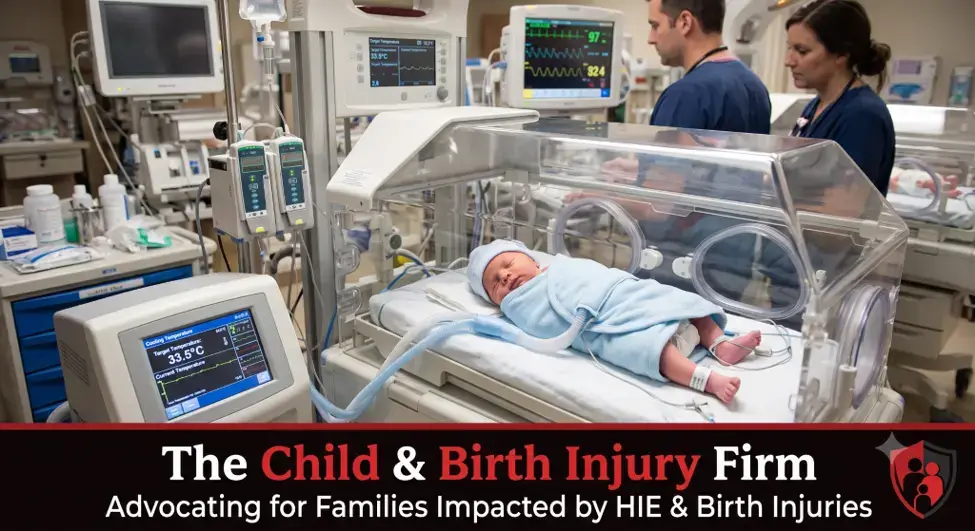
Therapeutic hypothermia — commonly called cooling therapy — is the primary evidence-based treatment for moderate-to-severe HIE. It involves lowering a newborn’s core body temperature to approximately 33–34°C for 72 hours to slow the cascade of secondary brain cell death that follows the initial oxygen deprivation event.
According to the American Academy of Pediatrics (AAP), cooling therapy is the standard of care for infants 36 weeks gestational age or older who meet specific clinical criteria. It must be initiated within six hours of birth to be effective.
The fact that your child received cooling therapy is legally significant. It documents that:
- The medical team recognized a qualifying brain injury had occurred.
- The standard of care for treatment was applied — raising the question of whether the standard of care for prevention was also met.
- The hospital’s own records will reflect the clinical assessment that triggered initiation of the cooling protocol.
Our catastrophic pediatric injury attorneys subpoena these records on day one of an investigation. Cooling therapy records, APGAR scores, umbilical cord blood gas values, and delivery room nursing notes are among the most powerful evidence in an HIE malpractice case.
What Medical Errors Most Commonly Cause HIE and Create Legal Liability?
HIE rarely occurs without a clinical precursor. Our child injury team has investigated thousands of birth injury cases and consistently identifies the following categories of preventable obstetric failure, and it rarely develops unless medical professionals or other medical providers miss warning signs during the birthing process:
Failure to Monitor Fetal Heart Rate
- Continuous fetal heart rate monitoring during labor is essential. Category I tracings are considered normal and are not predictive of fetal distress. In contrast, Category III fetal heart rate tracings are abnormal and indicate an increased risk of fetal acidemia. Category II tracings are indeterminate, requiring continued surveillance and re-evaluation to detect potential issues.
Delayed Emergency C-Section
When a baby is deprived of oxygen, timing can be critical. Hospitals differ in their ability to mobilize surgical teams, and major centers may be able to deliver within minutes while rural facilities may require more time. The relevant question is whether the response was reasonable given the emergency, the facility’s capabilities, and the available resources.
The Emergency Determines the Required Response
The appropriate timing depends on factors such as the fetal heart-rate pattern, maternal condition, persistence of fetal distress, suspected cause, and the risk that continued delay could cause injury. In some circumstances, immediate delivery may be necessary; in others, corrective measures and close monitoring may be appropriate.
Our experts can evaluate whether the medical team breached the applicable standard of care and whether any delay caused or materially contributed to the injury. A delay alone may not establish negligence, and conditions such as hypoxic-ischemic encephalopathy may have multiple causes.
What the Records May Show
A medical-record review may examine:
- Fetal heart-rate abnormalities and maternal vital signs;
- Interventions used to address distress;
- The decision to perform surgery;
- Notification and arrival of surgical, anesthesia, and neonatal teams;
- Incision, delivery, and neonatal resuscitation; and
- Blood-gas results and the baby’s subsequent condition.
Our legal team works with qualified medical experts, when appropriate, to assess timing, standard of care, and causation. Each case depends on its facts, the governing law, and the available evidence.
Umbilical Cord Complications
- Cord prolapse, nuchal cord (cord around the neck), and true knots can sometimes cut off fetal oxygen supply
- Medical teams must identify these risks before and during delivery
- Failure to diagnose or respond to cord complications is a recognized ground for malpractice
Mismanagement of Labor-Augmenting Drugs
- Oxytocin (Pitocin) administered in incorrect doses can cause uterine hyperstimulation, which can sometimes reduce oxygen delivery to the fetus
- Nursing and physician documentation of drug dosing is subpoenaed and scrutinized
Failure to Diagnose Maternal Conditions
- Untreated preeclampsia, gestational diabetes, placental abruption, and chorioamnionitis may all create fetal hypoxia risk
- Doctors know how to spot these health issues. When a medical team misses the warning signs or treats them the wrong way, it can be the first clear sign of medical malpractice.
Visit our birth injury resources page for detailed breakdowns of specific malpractice fact patterns we have successfully investigated.
What Evidence Is Required to Prove Obstetric Negligence in an HIE Case?
Proving an HIE birth injury case requires showing more than a bad outcome. Plaintiffs must establish four legal elements through direct and expert evidence:
- Duty — The hospital, obstetrician, or nurse-midwife owed a duty of care to the mother and baby. This is established by the existence of a physician-patient or hospital-patient relationship.
- Breach — The provider deviated from the accepted standard of care. This element can require sworn expert testimony from a qualified medical professional in the same field as the defendant. These are among the most complex medical malpractice cases because they involve intricate medical details and careful review of medical records. Every state with an affidavit of merit requirement — including New Jersey, Pennsylvania, Michigan, and dozens of others — mandates that this expert opinion be filed at or near the time the complaint is served.
- Causation — The breach directly caused the HIE injury. This is typically the most contested element. Defense experts will argue that the brain injury was caused by a prenatal event outside anyone’s control. Our team determines whether the child’s birth injury was caused by negligent care by reconstructing the timeline with fetal monitoring strips, delivery room records, and umbilical cord blood gas data.
- Damages — The injury caused quantifiable harm. In severe HIE cases, this encompasses lifetime care projections, adaptive equipment costs, educational supports, and the incalculable human cost of a life permanently altered.
Hospital systems usually deploy aggressive defense teams immediately after a birth injury. Every piece of documentation is reviewed and sometimes modified. Our investigators request preservation letters, begin a thorough investigation, and initiate formal discovery within days of being retained. In hypoxic ischemic encephalopathy cases, speaking with our experienced birth injury lawyers early can protect critical evidence. Contact our birth injury lawyers before the hospital gets further ahead of your family.
How Long Do Parents Have to File a Birth Injury Lawsuit for Their Child?
The statute of limitations for a birth injury claim varies by state and is one of the most dangerous legal hurdles for families who wait too long to seek counsel. After an HIE diagnosis, families should learn their legal options as soon as possible. However, most states recognize a critical protection for injured children: tolling of the statute of limitations for minors.
What tolling means: In some states, the filing clock does not begin to run until a child reaches the age of majority (typically 18). This means a family may technically have until the child’s 19th, 20th, or 21st birthday to file — depending on state law.
Critical exceptions:
- Some states impose an absolute repose period — a hard deadline that cuts off the right to sue regardless of the child’s age. For example, certain states impose a 10-year absolute limit from the date of injury.
- Claims against government-owned hospitals (such as municipal or VA facilities) may require a notice of claim to be filed within 90 to 180 days of the injury.
- Affidavit of Merit requirements in states like New Jersey and Pennsylvania mean that an expert certification must often be filed within the first months of the case — long before trial preparation begins.
Our experienced attorneys will review the applicable deadline rules and file an HIE lawsuit before the statute of limitations expires.
Our team of birth injury lawyers maintains deep familiarity with the legal process of protecting a child’s rights before deadlines run in every state where we handle cases. We do not allow a missed deadline to extinguish a child’s rights. Review your state’s rules at our legal resources page.
What Happens During the Discovery Phase When You Sue a Hospital System for HIE?
Discovery in a birth injury case against a hospital system is intensive, multi-layered, and requires a legal team that can protect the child’s well-being and the family’s interests while handling a complex hospital case. Here is what our process looks like:
Records Acquisition and Preservation
- Formal litigation hold letters sent to the hospital, delivery unit, and any employed physicians.
- Subpoenas issued for all prenatal records, labor and delivery records, nursing notes, fetal monitoring strips, NICU records, and pharmaceutical administration records, supporting a thorough investigation in severe hypoxic-ischemic encephalopathy cases.
- Preservation demand for electronic health records (EHR) metadata and audit trails, which reveal whether records were accessed or altered after the injury.
Request for Production of Documents * Demanding the Evidence: We use formal legal rules to force the hospital to hand over their private files. We know exactly which medical logs and fetal monitor strips to ask for.
- Requests for Hospital Policies: We legally demand the hospital’s internal labor and delivery rulebooks. This helps us prove the medical team broke their own safety rules.
- Internal Communications: We ask for emails and internal hospital reports that might talk about what went wrong during the delivery.
Expert Review and Liability Analysis
- Board-certified obstetric, neonatal, and pediatric neurology experts, including consultation with pediatric neurologists, are retained to review the full record.
- Expert witnesses prepare reports identifying the specific deviations from the standard of care.
- Experts may be engaged to analyze MRI and brain imaging findings.
Written Discovery and Court Motions
- Interrogatories and Requests for Admission: Formal written demands forcing the hospital to answer specific questions under oath and legally admit or deny crucial facts (e.g., exactly when fetal distress was first noted).
- Requests for Hospital Policies: We legally demand the hospital’s internal labor and delivery rulebooks. This helps us prove the medical team broke their own safety rules.
- Motions to Compel: Hospitals sometimes attempt to hide internal incident reports under “privilege.” Our attorneys aggressively litigate these disputes before a judge to compel the disclosure of hidden documents.
Depositions
- Medical Staff: Depositions of all treating obstetricians, nurses, anesthesiologists, and hospital administrators.
- Defense Experts: Cross-examination of the hospital’s hired medical experts under oath.
- The Parents: The defense will depose the parents regarding maternal health and prenatal history. Our team thoroughly prepares and protects families during this emotional but necessary step.
- Note: Depositions may extend over many months in complex institutional cases.
Defense Medical Examinations (DMEs)
- The defense has the right to hire their own pediatric experts to physically examine the child.
- Their goal is often to minimize the severity of the injury or argue for a shorter life expectancy to reduce financial liability.
- Our legal team sets strict legal boundaries for these exams to protect your child from unnecessary distress and prevent defense overreach.
Damages Documentation
- Life care planners calculate the projected cost of lifetime care for the child.
- Vocational rehabilitation experts assess lost earning capacity.
- Forensic economists present present-value calculations to the jury.
This process demands a law firm with the financial resources to front significant litigation costs. Our catastrophic pediatric injury attorneys and HIE lawyers advance all case expenses. Families pay nothing unless we win.
How Are Lifetime Care Costs Calculated for a Child Severely Disabled by HIE?
In moderate-to-severe HIE cases involving permanent disability and severe brain damage, lifetime care costs are often central to securing maximum compensation and financial compensation — often exceeding millions of dollars over the course of a child’s life.
A certified life care planner constructs a document called a Life Care Plan, which itemizes:
- Medical and therapeutic services: Neurology, physiatry, physical therapy, occupational therapy, speech therapy, and behavioral health — projected across the child’s full life expectancy, including future surgeries and rehabilitation therapies as part of ongoing medical care
- Assistive and adaptive technology: Power wheelchairs, communication devices, orthotics, and environmental controls
- Durable medical equipment: Hospital beds, lifts, positioning systems, and specialized feeding equipment
- Home modifications: Ramp access, widened doorways, roll-in showers, and dedicated caregiver quarters
- In-home nursing care: 24/7 nursing for children with complex medical needs can cost $200,000 to $400,000 or more annually
- Residential placement: For children who cannot remain in the home, specialized residential facilities represent a separate and substantial cost line
- Lost earning capacity: An economic expert will calculate the income the child would have earned across a working life but for the injury
- Education and developmental supports: Special education services, one-on-one aides, and transition planning into adulthood; some children require ongoing medical care and may require ongoing medical care for life
All settlements and verdicts on behalf of a child must receive court approval. A judge reviews the proposed settlement, confirms it is in the child’s best interests, and may require that proceeds be placed into a court-supervised structured settlement or special needs trust to protect the child’s eligibility for government benefits. Our team works closely with special needs trust attorneys to protect every dollar recovered, and any court-approved recovery must account for the child’s lifelong care and other lifelong challenges.
What Long-Term Outcomes Should Our Family Understand After an HIE Diagnosis?
The long-term outcomes of HIE vary by severity grade, the quality of early intervention, and access to ongoing therapeutic support. Research published in peer-reviewed journals and compiled by the National Institutes of Health documents the following outcome patterns:
Mild HIE: Most children with mild HIE who receive prompt cooling therapy have near-normal developmental trajectories, though subtle learning disabilities, attention difficulties, and behavioral challenges have been reported in school-age follow-up studies.
Moderate HIE: Approximately 25–30% of children with moderate HIE develop cerebral palsy. Epilepsy, intellectual disability, vision impairment, and language delays are common. Long-term outcome is heavily influenced by the extent of injury visible on MRI, typically performed at 24–72 hours of life.
Severe HIE: Mortality rates are high in severe HIE. Survivors face profound neurological disability, including spastic quadriplegic cerebral palsy, cortical visual impairment, intractable seizure disorders, and complete dependence on caregivers. Many children with severe HIE will require residential placement in specialized care facilities.
Early intervention matters. Physical, occupational, and speech therapy begun in the first year of life can meaningfully improve functional outcomes even in children with moderate-to-severe injury. The compensation our team fights for is designed to fund exactly this kind of intensive, sustained care. Speak with our child injury team about what a full recovery plan may look like for your child.

Top 10 Frequently Asked Questions About HIE Lawsuits
We understand that an HIE diagnosis is terrifying, and the thought of pursuing legal action can feel overwhelming. Below are the most common questions our legal team receives from families searching for answers.
- Does an HIE diagnosis automatically mean the hospital committed malpractice? No. While many cases of HIE are caused by preventable medical errors, some are caused by unavoidable complications (such as early genetic factors or sudden, unforeseeable cord events). This is exactly why an independent, expert legal review of your medical records is necessary to uncover the truth.
- The hospital told us “these things just happen.” Should we believe them? Be extremely cautious. Doctors and hospital risk managers are trained to protect the hospital from liability. They will rarely admit fault voluntarily. The only way to know definitively what happened is to have an independent medical expert review the fetal monitoring strips and delivery records.
- How much does it cost to hire an HIE birth injury lawyer? Nothing upfront. Our firm works on a contingency fee basis. We advance all the costs of the investigation, expert witnesses, and litigation. We only get paid if we successfully recover financial compensation for your child.
- Who can we sue for our child’s HIE injury? Liability can fall on multiple parties, including the attending obstetrician, maternal-fetal medicine specialists, labor and delivery nurses, anesthesiologists, and the hospital system itself.
- How much compensation is my child entitled to? Every case is unique. Compensation is determined by the severity of the injury, the projected cost of lifetime care (via a Life Care Plan), lost future wages, and non-economic damages like pain and suffering. Severe HIE settlements and verdicts frequently reach well into the millions of dollars to ensure the child is cared for over their entire lifespan.
- Will our family have to go to court and testify? The vast majority of medical malpractice cases are settled out of court before a trial begins. However, we prepare every single case as if it is going to trial. If the hospital refuses to offer a fair settlement that covers your child’s lifelong needs, we will not hesitate to present your case to a jury.
- How long does an HIE lawsuit take? Because of the complexity of the medical evidence, the need for multiple expert witnesses, and the tactics used by hospital defense teams, an HIE lawsuit can typically take several years to resolve.
- Can we still sue if my child is older and the injury happened years ago? In many cases, yes. Some states “toll” or pause the statute of limitations for minors, meaning you may have until your child turns 18 (or older) to file a claim. However, because evidence can be lost over time and some states have strict absolute deadlines, you should speak to a lawyer immediately.
- What if we don’t have access to our child’s medical records? You do not need to have your records to contact us. Once you retain our firm, we handle the legal process of formally requesting, subpoenaing, and securing all necessary electronic health records and fetal monitoring strips directly from the hospital.
- How do we get started with an investigation? The first step is a free, confidential consultation. You will speak directly with our team, share your child’s birth story, and we will advise you on whether we believe you have a viable legal claim.
About The Child and Birth Injury Firm
The Child and Birth Injury Firm has represented families nationwide who have been devastated by preventable birth injuries and catastrophic pediatric harm. Our team handles complex HIE lawsuits and related medical malpractice claims arising from preventable birth injuries, bringing decades of combined experience taking on hospital systems, insurance carriers, and corporate medical defendants. We have the resources, the medical experts, and the will to see every case through to maximum accountability, and we are prepared to pursue maximum compensation for a child’s future needs. Attorney Killino has built his career on an unyielding commitment to children who have been harmed by the negligence of those entrusted with their care. He holds medical institutions accountable not just in the courtroom, but in the record — building the kind of documented, expert-supported cases that force powerful defendants to answer for what they did. If your child received an HIE diagnosis and you believe medical error played a role, contact our birth injury lawyers today for a free consultation with an experienced attorney who can explain your legal options and support your family as you navigate your child’s condition after suspected medical negligence.